









CHROMOSOME 22 CENTRAL 
SUPPORT FOR
ALL CHROMOSOME 22 RELATED DISORDERS 

We are all about connecting! 
Click here for an online membership form to JOIN US!
 
Registered members receive our newsletter and can choose to be listed in our parent registry.

C22C is a parent driven group with more than 1000 members in 45+ countries. 

HOME | EVENTS | RESEARCH | NEWS | LINKS | PRIVACY POLICY | DISCLAIMER


CLICK HERE FOR E-MAIL SUPPORT LISTS  

MESSAGE BOARDS

FAMILY STORIES

FACEBOOK GROUP

MEMBERSHIP FORM

C22C INTERNATIONAL PARENT CONTACTS

LEARN ABOUT

DOWNLOAD A .PDF COPY OF OUR BROCHURE - SPREAD THE WORD!

Chromosome 22 Central Inc. is a registered Canadian Non-Profit Organization 
and Registered Charity BN# 86009 3665 RR0001, and a Registered US Corporation with Non-Profit Status


STUDY ANNOUNCEMENT - 
ALBERT EINSTEIN COLLEGE OF MEDICINE

We are announcing an IRB-approved study (Albert Einstein College of
Medicine) on chromosome rearrangements and mental retardation. Dr.
Bernice Morrow and I here at Montefiore Medical Center are
particularly interested in persons who have chromosome rearrangements
involving the 22q11 region such as translocations, deletions (velo-
cardio-facial syndrome/DiGeorge syndrome, VCFS/DGS) or those who have
a clinical diagnosis of VCFS/DGS but not have a detectable deletion.
If you have any patients who meet this criteria, please contact me to
discuss your case. Thank you.

Suzanne M Carter,MS,  Reproductive Genetics
Montefiore Med Ctr,  Bronx, NY 10461
TEL: 718.405.8158   FAX: 718.405.8154


Individuals with a balanced chromosome translocation or inversion:

Researchers affiliated with Harvard Medical School are involved in a research study to find genes that are important in human development.  The Developmental Genome Anatomy Project (DGAP) aims to study genes that have been altered by chromosome rearrangements.  In some individuals a balanced chromosome rearrangement is associated with mental impairment and/or physical abnormalities.  It is possible that when the rearrangement occurred a gene (or genes) were broken or placed out of order, resulting in developmental problems.

The focus of the DGAP investigation is to study the chromosomes and genes from individuals with balanced chromosome rearrangements such as inversions or translocations who also have physical abnormalities, disabilities, and/or mental impairment.  Such individuals are usually the first in the family to have a chromosome rearrangement (the parents do not have the rearrangement and do not have the same medical problems).  Participation in DGAP involves giving a blood sample at your local doctor’s office, reviewing and signing the consent form, and asking your doctor to provide medical records.  The identity of the participant and results are kept confidential.  It is hoped that the research will contribute to a better understanding of how the human body grows and develops.

For more information please contact Heather Ferguson, M.S. at hferguson1@partners.org or 1-866-772-5753, or Azra Ligon, Ph.D. at aligon@rics.bwh.harvard.edu or 1-617-732-7671

Please see our web site at http://dgap.harvard.edu


RESEARCH LINKS

Children's Hospital of Philadelphia -studying 22q11 rearrangements, deletions, translocation (11;22)

Albert Einstein College of Medicine- studying 22q11 rearrangements, deletions, translocation (11;22)

University of Alberta- studying Cat Eye Syndrome (partial trisomy/tetrasomy 22) and 22q13 deletion

M.I.N.D. website at http://cabil.mindinstitute.org 
Marisol Q. Mendoza, M.A.
Clinical Research Coordinator
Cognitive Analysis & Brain Imaging Laboratory (CABIL)
M.I.N.D. Institute
University of California, Davis
Phone: (916) 703-0408
Fax: (916) 703-0333
mqmendoza@ucdavis.edu

Center for the Diagnosis, Treatment and Study of Velo-Cardio-Facial Syndrome
Dr. Robert J. Shprintzen, Director
SUNY Upstate Medical University
Jacobsen Hall
175 Elizabeth Blackwell Street
Syracuse, NY 13210
(315) 464-6590
Fax: (315) 464-6593

Small Supernumerary Marker Chromosomes
Institute of Human Genetics and Anthropology
Jena, Germany

Sanger Center- sequencing

Rockefeller University (studying Schizophrenia/OCD/22q11 relation) study information

University of Oklahoma

Keio University School of Medicine

University of Tübingen

St. Louis Genome Sequencing Center

Pipet's Parlour (Bi-Polar Disorder/Schizophrenia in relation to Chr 22)

Cytogenetic and Molecular Studies of Human Chromosome 22

Immunologic Evaluation in Patients With DiGeorge Syndrome or Velocardiofacial Syndrome

Study of Phenotype and Genotype Correlations in Patients With Contiguous Gene Deletion Syndromes

The VCFS Study at Stanford

Visuospatial Cognitive Deficit in Del22q11.2 Syndrome


CURRENT RESEARCH

WE ARE HAPPY TO PROMOTE RESEARCH STUDIES 
AND UPCOMING EVENTS OR NOTICES. 
PLEASE CONTACT US TO HAVE YOUR INFORMATION ADDED TO THIS WEBSITE steph.stpierre@gmail.com

See below left index to links to research centres


Molecular Study of Balanced Chromosome Translocations

A chromosome translocation is the interchange of parts between nonhomologous chromosomes. It is detected on cytogenetics or a karyotype of affected cells in affected persons. Chromosome translocations can be balanced (in an even exchange of material with no extra or missing genes) or unbalanced (where the exchange of chromosome material is unequal resulting in extra or missing genes).

Approximately 1 in 3000 live births has a de novo balanced chromosomal translocation and 6 % of infants of these translocation carriers have multiple congenital anomalies, which include isolated defects ranging from cleft palate/lip, abdominal wall defects, craniofacial anomalies, limb defects, cardiac abnormalities or intellectual disability, speech delay, cognitive impairment, genitourinary abnormalities, or they can occur as
part of known clinical syndromes. Medical College of Georgia in United States has been working on these balanced chromosome translocations to identify disrupted disease genes at the breakpoints.

Developmental Gene Discovery Project (DGDP) by Dr. Lawrence Layman and Hyung-Goo Kim is based at the Medical College of Georgia within the Institute of Molecular Medicine & Genetics.


The symptoms seen in the carrier of balanced chromosome translocation is generally caused by a gene/genes disrupted at the one of the breakpoint of translocation. So the aim of this study is to discover the genes that cause the disorders by sequencing the breakpoints of balanced chromosome translocations. To identify which genes are at the breakpoints will shed light on understanding the cause of this devastating disease.

This will lead the way towards greater understanding of the mechanisms how genetic disorders occur. Ultimately we aim to improve the services and treatment to the affected families.

Most importantly, we will keep the families informed of progress made in our research by telling which gene is disrupted at the breakpoint of the carrier of balanced chromosome translocation.

We are also willing to initiate molecular study of balanced chromosome translocations involving chromosome X as well to identify the cause of intellectual disability and other congenital anomalies.

We have already a couple of individuals participating in this study and there is no cost for you to participate in this molecular research study.  We will request small amount of blood samples from you and available family members in order to determine the breakpoint and parental origin of the translocation. Additionally we will need consent forms signed. We will pay shipping costs by providing our Fedex number.
Contact email: hkim@chgr.mgh.harvard.edu (Hyung-Goo Kim)  or lchorich@mcg.edu (Lynn Chorich) Contact telephone number: 001-706-721-7591


VOLUNTEERS NEEDED FOR CHILDREN’S STUDY

VCFS is short for Velo-Cardio-Facial Syndrome. VCFS is a medical condition which is caused by the deletion of a small part of one of a person’s two chromosomes 22. The deletion occurs on the longer arm (or Q arm) of the two arms of this chromosome 22. Another name for VCFS is therefore 22Q11 Deletion Syndrome (or 22Q11DS). VCFS is sometimes also referred to as DiGeorge syndrome, particularly when children have heart problems. 

Children with VCFS can experience learning difficulties. They may also experience behavioural problems at home and in school and may find it more difficult to make friends. Sometimes, their thinking and speech may be difficult to follow or may seem unusual to others. It is not clear at the moment to what extent children with VCFS are at risk for these problems.  

Researchers also don’t know to what extent the genetic deletion plays a role in the behavioural and thought problems some children with VCFS experience. It is possible that the learning difficulties that children with VCFS can have contribute to their risk of behavioural and thought problems. However, if and to what extent they do is not understood.   

Understanding more about the relations between learning, behavioural and thought problems in children with VCFS may lead to more effective methods of treatment and prevention, thus improving the lives of children and families affected by this disorder.  

Our study aim is to better understand the developmental pathways of VCFS. We therefore are interested in assessing the behaviour, and the psychological and intellectual functioning of children with VCFS.

The study has ethical approval and is conducted by University Hospital Cardiff. Dr. Marianne van den Bree is the principal investigator.

Participation involves:

  • Assessment of the child’s symptoms via clinical interview with the parent.
  • Short interview with the child about how they experience themselves and others. 
  • Assessment of the child’s cognitive ability. This involves completing a number of puzzles.
  • Blood or saliva sample from the parents and the child for DNA extraction

Participation in this project is entirely voluntary. All participating families will be reimbursed for their time. All information gained from the study will be confidential. You are free to withdraw from the study at any stage.  

If participating families like to, we can provide their clinician with the information gathered in the study and this may be helpful for treatment. We hope that the project will provide greater insights into the development of 22Q11DS and this may in turn contribute to the development of new treatment strategies in the future.

Your family may be eligible for the study if:

  • You have a child who is 7-11 years who has been diagnosed with VCFS.

If your child has a sibling who does not have VCFS we would also ask them to take part. However, families of children with VCFS who do not have a sibling can still take part. 

For more information please contact:

Anna or Hayley on 029 2074 4002, E-mail: echo@cardiff.ac.uk 
Dr Marianne Van den Bree, Cardiff University Hospital, Department of Psychological Medicine, School of Medicine, Cardiff University, Heath Park, Cardiff, CF14 4XN.


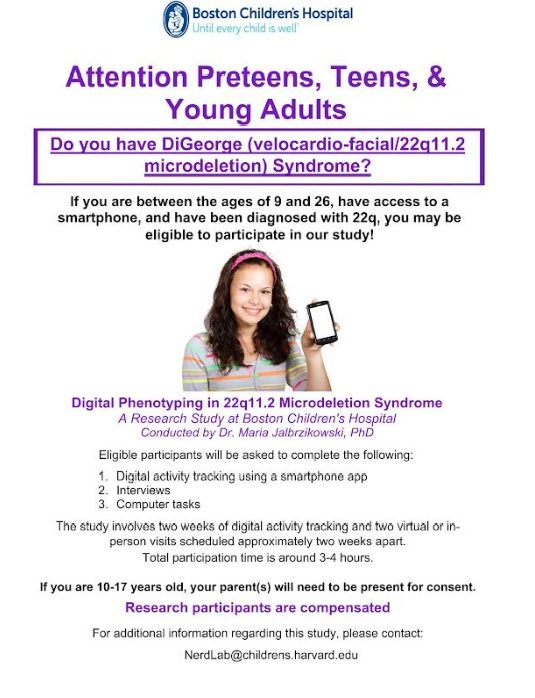
Does your child have the 22q11.2 deletion? Help us learn about
pregnancies of babies with velocardiofacial/ DiGeorge syndrome.


We are looking for families interested in helping to identify early
signs of the 22q11.2 deletion syndrome seen during pregnancy. This
research will be conducted at Tufts Medical Center via medical chart
review of pregnancies of babies with 22q11.2 deletion syndrome. To
participate, your child must have confirmed diagnosis of the 22q11.2
deletion syndrome. The child must also be currently less than ten
years of age. The study involves completing a questionnaire and
allowing us to view the records about the pregnancy of your child
which will be kept completely confidential. You will not need to have
blood drawn nor do you need to be present during the chart review.
Information gathered from this study may improve care of children in
the future with the 22q11.2 deletion syndrome by allowing for early
diagnosis, improvement in pregnancy management, and assistance in
postnatal care for future families who may have a child with the
22q11.2 deletion syndrome. If you are interested in participating, or
have any questions regarding this study, please contact the principal
investigator, Dr. Jodi Hoffman, at (617) 636 – 7721.  


CHOP Cardiology Studies

Children’s Hospital of Philadelphia is seeking children and adolescents with the 22q11.2 deletion ages 8-18 to participate in a study investigating the health of children with heart defects as they grow older, in the hopes of improving clinical care. Participants must have one of the following heart conditions: tetralogy of fallot, truncus arteriosis, or interrupted aortic arch. Interested participants can contact Andrea Mullen RN at 267-426-2862 or mullena@email.chop.edu

Influenza Study at Children’s Hospital of Philadelphia winding down

Don’t miss your chance to participate! Patients with a chromosome 22q11.2 deletion interested in a study to understand who most benefits from the yearly influenza vaccine, are invited to call Tiketta Mintyre at 215-590-2186 for more details! The study is in its final year so call soon if you or your child would like to participate!

New Research Study of Children and Adolescents with the 22q11.2 Deletion at the University of Minnesota.

Researchers at the University of Minnesota are studying brain structure and functions in individuals with the 22q11.2 deletion between the ages of 8-19. Testing will occur in Minneapolis, MN there is no cost for participating. Families will receive feedback on the results. A stipend is provide. For more information, please contact Dr. Tonya White or Angie at 612-2 7 3 - 9 8 3 4 o r e m a i l tcvcfsgroup@hotmail.com.

International Consortium Attempting to Unravel the Clinical Variability in Patients with a 22q11.2 deletion.

Researchers at CHOP, along with an international consortium lead by Bernice Morrow, PH.D., from the Albert Einstein College of Medicine in New York, are attempting to understand the clinical variability observed in patients with a 22q11.2 deletion by examining differences in genes on chromosomes other than chromosome 22 and, in addition, by looking at the non-deleted chromosome 22. To this end, they are attempting to obtain DNA samples on over 2500 individuals with a 22q11.2 deletion and where possible, their parents. They will also need clinical information in the form of medical records, such as echocardiograms, on those individuals with a 22q11.2 deletion. To learn more about this study, or to request “spit kits” for DNA collection and mailing, please call the “22q11 and You” Center at 215-590-2920 or email them at genetics@email.chop.edu.

Announcing an Innovative CHOP/ PENN Partnership to Understand Brain Behavior in Pre-Adolescence, Adolescents and Adults with a 22q11.2 Deletion.

Clinicians and researchers at CHOP and the University of Pennsylvania School of Medicine, are pleased to announce a new partnership to better understand the brain and behaviour in adolescents and adults with the 22q1.2 deletion. To this end, they will be recruiting patients ages 8 and older. There is no cost to participate and feedback will be given regarding the results of study measures. A stipend will also be provided. For more information, please call the “22q and You” Center at 215-590-2920 or email them at genetics@email.chop.edu.


22q11.2 Deletion Syndrome (Velocardiofacial Syndrome) -Cognitive Function and Brain Structure Research Study

 Many people with 22q11.2 Deletion Syndrome (Velocardiofacial Syndrome) have a greater chance of having attention deficits, learning disabilities, and particular psychiatric conditions such as autistic spectrum disorders. While there is no known cure for this genetic syndrome, there is a lot of exciting research happening in this area.  UCLA investigators have recently begun a study to further expand knowledge of 22qDS in humans. This research study is conducted jointly by investigators Carrie Bearden, Ph.D., UCLA Departments of Psychiatry and Biobehavioral Sciences and Psychology, Katrina Dipple, M.D., Ph.D., UCLA Departments of Human Genetics and Pediatrics, and Christina Palmer, Ph.D., UCLA Department of Psychiatry and Biobehavioral Sciences. The goal of the study is to examine emotional adjustment, thought processes such as memory and attention, and brain structure and activity in children and adolescents with 22qDS, as compared to children and adolescents without the disorder. The study also aims to determine whether variation in the specific genes affected by 22qDS is related to differences in brain structure, function and behavior. Funding for this study is provided by the UCLA Center for Autism Research and Treatment (CART).

What will participation include?

Participation may take between one to two days (~5-6 hours for all study procedures). Participants will be given paper and pencil and computer tests of memory, attention and logic, and interviews about their mood, thoughts and behaviors by a trained staff member at the UCLA Center for Cognitive Neuroscience, and an MRI scan at UCLA’S Brain Research Institute. These tests will help us to learn more about how the brain works in people with 22qDS.  A comprehensive assessment for autistic spectrum disorders will be conducted. The study also involves a review of medical records, to get information about birth and medical history, and an optional blood or saliva sample, to determine whether the genes affected by 22qDS may be related to differences in behavior. All procedures will be explained carefully and all participation is completely VOLUNTARY. There are minimal risks involved with participating in this study. You may withdraw from the study at any time.  There is no financial obligation on the part of the participant. You will receive a brief report about the test results from the clinical interviews and cognitive assessments.

In addition, participants will be compensated up to $60 for full participation in this study. If after the initial evaluation it is determined that you are not eligible for the study you will be compensated $20 for your time. This is not a treatment study; however, it is hoped that the information gathered from this study may help to develop treatments for the disorder in the future.

 Who may be eligible to participate?

 1. Individuals between the ages of 8 to adult, with a confirmed diagnosis of 22q11.2 deletion.

 2. No diagnosis of a disorder of the brain or nervous system (such as encephalitis, brain tumor, etc.)

 3. No current drug or alcohol abuse

 4. Able to complete the study measures and interviews in English.

 CONTACT INFORMATION

If you are interested in finding out more about this research study, please call Molly Hardt at (310) 794-9730 or email her at:  hardt@psych.ucla.edu. You may also contact the Principal Investigator of the study, Dr. Carrie Bearden, at cbearden@mednet.ucla.edu

 *Individuals under 18 must have their parents call.

 Principal Investigator: Carrie Bearden, Ph.D.

Department: UCLA Semel Institute, Dept of Psychiatry and Biobehavioral Sciences


Dr. Beverly Emanuel and colleagues are looking into a translocation which occurs between chromosomes 8 and 22 - t(8;22)(q24;q11). If you are a translocation carrier and/or have a child affected with either a balanced or unbalanced translocation between 8 & 22, and are interested in participating in research, please contact her at the address below:

Beverly S. Emanuel, Ph.D.
Professor of Pediatrics
University of Pennsylvania School of Medicine
Chief, Division of Human Genetics
The Children's Hospital of Philadelphia 
Abramson Research Center, Room 1002 
3615 Civic Center Blvd.
Philadelphia, PA 19104-4318
E-mail: beverly@mail.med.upenn.edu 
Phone: 215-590-3856 


LOOKING FOR t(11;22) de novo carriers

Dr. Emanuel's group is trying to examine the mechanism of the t(11;22) translocation to understand how it happens. They especially want to find out whether it can happen in female meiosis as well as in male meiosis. In order to do this, they look at samples from new translocation carriers, which are rare. They need to study individuals who have the balanced translocation, but neither of their parents is a carrier or they can study individuals who have an Emanuel Syndrome affected child and neither of them is a carrier. These are what are called de novo cases. Thus, if there are any de novo carriers willing to participate in research please email me at steph.stpierre@gmail.com .


Dear Families with a 22q11 deletion:
We are trying to find genes that that are responsible for predicting severity of velo-cardio-facial syndrome in children and adults with the disorder. We need saliva
samples or blood from families (child-mom-dad).  We are in need of specimens for whom the affected child has no heart defects and those for whom the child has had very severe heart defects, such as tetralogy of Fallot .  We need to obtain a copy of an echocardiography report for both categories as well as the ability to obtain additional basic clinical information from your doctor.  We have kits we can send to you that are pre-paid. All information will be kept confidential.  This  study would tremendously help future generations of children with the disorder.  If you are interested in participating, or have questions, please email me at morrow@aecom.yu.edu (and ablonska@aecom.yu.edu).  Thanks much.  

Bernice Morrow
Professor of Molecular Genetics and Ob/Gyn/Women's Health
S.L. and M.K. Olson Professor of Cardiology
Director of the Division of Translational Genetics
Albert Einstein College of Medicine
1300 Morris Park Ave
Bronx NY  10461
Phone:  718-430-4274
Fax:  718-430-8778
email:  morrow@aecom.yu.edu


A study is being conducted by the Clinical Immunization Safety Assessment (CISA) Network. This is a national network of experts in the field of immunization safety studies. The study is open to children with congenital anomalies consistent with 22q11.2 deletion syndrome such as DiGeorge syndrome (DGS) or velocardiofacial syndrome (VCFS). The purpose of this study is to help doctors determine which children with a deletion in the chromosome 22q11.2 can be safely immunized. There are no additional lab tests, shots, or medicines for this study. Your child will not be seen or examined. Study investigators at Columbia University Medical Center would review information that already exists in medial records. If you want more information about participating in this study please contact the Columbia University Research Assistants.
Either Ximara Peckham (Phone: (212) 305-2876, Email- xp2101@columbia.edu) or Kathleen Jakob (Phone: (212) 305-2790, Email- kj160@columbia.edu). This study has been approved by the Columbia University Medical Center Institutional Review Board (IRB).”

Please do not hesitate to contact us if you have any questions. Philip L. Graham III, MD MS is the Principal Investigator for this study, and can be reached at (212) 305-2790. My name is Kathleen Jakob (Phone: (212) 305-2790, Email kj160@columbia.edu) and I am the study coordinator.

Sincerely,
Kathleen Jakob, RN BSN
Division of Pediatric Infectious Diseases
Columbia University Medical Center
New York, NY


CAT  EYE SYNDROME RESEARCH

The Children’s Hospital of Philadelphia has long been involved in the study of genetic alterations of chromosome 22. With support from the National Organization for Rare Diseases, Dr. Emanuel’s laboratory is embarking on a research study entitled “Improving the Diagnosis of Cat-Eye Syndrome.”  Our primary goal for this research project is to develop and test a high-resolution, high-throughput technique to efficiently detect the duplications of 22q11.2 associated with the Cat-Eye syndrome.  We will design DNA probes from the sequence of human chromosome 22 to assess copy number differences of 22q11.2 in order to make the test readily available to molecular and molecular cytogenetic diagnostic laboratories.

We are eager to receive samples from individuals with a diagnosis of cat-eye syndrome to test the sensitivity of this new “kit.” To participate in this study you or your child must have a diagnosis of Cat-Eye syndrome on the basis of either phenotypic findings or cytogenetic analysis.

Participation will consist of providing information regarding the individual’s medical findings relevant to the diagnosis of Cat-Eye syndrome. This could, potentially be transmitted as part of a telephone interview with one of our genetic counselors.  Alternatively, this might require review of medical records.  Participants will also be asked to provide a blood sample for DNA and chromosome analysis.

Any individual with a diagnosis of Cat-Eye syndrome is welcome to participate. Another goal of the study is to document the frequency of various types of problems in individuals with Cat-Eye syndrome in relation to the amount of genetic material that is duplicated.  This will help us to investigate the reasons for different features and symptoms that are seen in individuals with Cat-Eye syndrome. If there are multiple family members with the diagnosis, we would like to involve your family in a more detailed analysis of the genetic aspects that could potentially lead to recurrence of Cat-Eye syndrome. If you would like to learn more about this opportunity or to participate in our study, please contact Donna McDonald-McGinn, M.S. at (215) 590-2920 or via email at MCGINN@email.chop.edu.  


CHOP Research Studies Vaccine Response

Influenza is a serious illness. Yearly outbreaks of influenza are due to small changes in the influenza virus which arise each year, requiring annual vaccines to provide protection. Many people feel that we are facing an impending major epidemic in the near future. We know that there are some immune compromised patients, due to a chromosome 22q11.2 deletion, who are at risk for serious disease from influenza because their bodies cannot fight off the infection. Unfortunately, these patients may not respond well to the vaccine, making it difficult to protect them from influenza. With this in mind, Dr. Kathleen Sullivan, Chief of Immunology, is conducting a study at the Children's Hospital of Philadelphia, trying to determine whether there are ways to predict who will respond to influenza vaccine and who would require other strategies. She is therefore recruiting children and adults with a chromosome 22q11.2 deletion who would be interested in participating in this study. Specifically, the patients will receive the vaccine and have a number of immunologic studies to determine whether they produce appropriate antibodies to the vaccine and whether any predictors of vaccine responsiveness can subsequently be identified. If you or someone you know is interested in participating in this study, please contact Marrisa Kuba, RN at 267-426-2384.


t(11/22) GENE EXPRESSION STUDY:

I am a post-doctoral researcher at the University of Lausanne in Switzerland and am setting up a study to look at the effect of the t(11;22) translocation on gene expression in both balanced translocation carriers and individuals with the der(22) chromosome.

I will be looking at the genes in the region of the breakpoints on both chromosome 11q23 and 22q11. The main aim of the study will be to determine the differences in the expression of these genes between cytogenetically normal individuals, balanced translocation carriers and individuals with the der(22) chromosome. The results from this study will hopefully provide us with a deeper understanding of the cause of the developmental problems associated with Emanuel syndrome.

I am seeking individuals or families with the t(11;22) balanced translocation and those with the der(22) chromosome. Individuals wishing to be involved in the study will be asked to supply a blood sample and sign a consent form. All information will be treated confidentially.

For more information about the study, feel free to contact me:

Louise Harewood
Center for Integrative Genomics
University of Lausanne
Genopode Building
CH - 1015 Lausanne
Switzerland

Tel: +41 (0)21 692 39 67

e-mail: Louise.Harewood@unil.ch


CAT EYE SYNDROME RESEARCH OPPORTUNITY

Cedars-Sinai Medical Center is a world leader in the study of genetic conditions. The Department of Medical Genetics at Cedars-Sinai Medical Center, in conjunction with support from the National Organization for Rare Diseases, is conducting a research study involving individuals with a diagnosis of cat-eye syndrome. In order to participate in this study you or your child must have a known diagnosis of Cat-Eye syndrome. Participation will consist of:

1) A review of medical records, limited only to those records that address issues and treatment related to the diagnosis of cat-eye syndrome.

2) A telephone interview with one of the study coordinators to discuss your/your child’s history and quality of life issues.

Any individual with a diagnosis of cat-eye syndrome is welcome to participate. The study coordinators are particularly interested talking with individuals that are age 10 or older. The purpose of the study is to document the frequency of various types of problems in individuals with cat-eye syndrome as they get older.

The researchers are also interested in investigating the reason for the different symptoms that we see in individuals with cat-eye syndrome. If there are multiple family members with the diagnosis, we would like to talk with your family about a special part of the study that involves detailed

analysis of the genetic changes that lead to cat-eye syndrome. If you would like to learn more about this opportunity please contact Nancy Kramer, M.S. at (310) 423-9943 or via email at nancy.kramer@cshs.org.


22q11.2 Brain and Cognition Study

Dr. Tony Simon, Ph.D. invites your 7- to 14-year-old with a chromosome 22q11.2 deletion to participate in a research study on learning difficulties with math and related cognition. The study involves examining the structure and function of brain regions that affect visual-spatial and numerical abilities. The goal of the study, funded by the National Institutes of Health, is to develop interventions aimed at reducing these cognitive difficulties.

Children who participate in the study will complete the “Space Ship Training Program,” which includes computer games, a brain MRI scan and neuropsychological tests all wrapped in a “spaceship” or other fun theme. Children play a computer game and watch a simulated in-flight movie in the MRI scanner. MRI scans do not involve any radiation and all tests are safe and painless. Participation involves two visits, which will take approximately four hours each to complete. All testing is for research purposes only, is at no cost to families and includes a gift for your child.

As of February 2005, the study has moved to the M.I.N.D. (Medical Investigation of Neurodevelopmental Disorders) Institute at the University of California, Davis.  For further information contact:

Clinical Research Coordinator
Cognitive Analysis & Brain Imaging Laboratory (CABIL)
M.I.N.D. Institute
University of California, Davis
Phone: (916) 703-0408
Fax: (916) 703-0333
cabil@ucdmc.ucdavis.edu

You may also check the M.I.N.D. website at http://cabil.mindinstitute.org

Dr. Simon has several articles available for download on his website. Click here.


VCFS/DiGeorge Syndrome Research Study

Drs. Kucherlapati and Finn of the Department of Genetics are conducting a VCFS research study at Children’s Hospital, Massachusetts General Hospital, and Brigham and Women’s Hospital in Boston, Massachusetts.

This study is looking at the relationship between changes in genes and the observed medical conditions seen in patients with VCFS/DiGeorge Syndrome, and their family members.   We are looking for children and adults with VCFS, and their family members (parents, siblings) both with and without VCFS who are interested in participating in a research study. 

Participation would involve a visit to the hospital, lasting about two hours.  At the visit, patients with VCFS will have a physical examination, a review of their medical and family history, and a blood sample collection.  Family members will also be asked to provide a small sample of blood.  We will use this blood to isolate DNA and look for changes in genes that might be associated with different medical conditions in VCFS.  We hope that the results of this study will help us understand VCFS and provide better care to these patients in the future. 

For more information about this study, please contact the study coordinator, Erica Tworog-Dube, MS, at etworog-dube@partners.org or (617) 525-4490.


Neuropsychiatric Aspects of VCFS/DiGeorge Syndrome

Drs. Kucherlapati and Finn of the Department of Genetics are conducting a VCFS research study at Massachusetts General Hospital and Brigham and Women’s Hospital in Boston, Massachusetts.

This study is looking at the relationship between changes in genes and psychiatric and neurological conditions seen in patients with VCFS/DiGeorge Syndrome.   We are looking for adults over the age of 18 with VCFS who are interested in participating in a research study.  

Participation would involve a visit to the hospital, where an MRI scan of the brain will be completed, as well as a standardized psychiatric interview.  At the visit, patients with VCFS will have a physical examination, a review of their medical and family history, and a blood sample collection.  Participants will receive compensation for study participation, as well as reimbursement for travel expenses. In addition, results of the MRI and psychiatric assessment will be made available. We hope that the results of this study will help us understand VCFS and provide better care to these patients in the future.  

For more information about this study, please contact the study coordinator, Erica Tworog-Dube, MS, at etworog-dube@partners.org or (617) 525-4490.


STUDY ANNOUNCEMENT - SUNY Upstate Medical University

Our laboratory studies the brain and behavioral development of children with velocardiofacial syndrome (VCFS).  VCFS is caused by a microdeletion in the long arm of chromosome 22 (22q.11) and is associated with craniofacial anomalies, cardiac defects, learning disabilities, and psychiatric disorders.  Up to 30% of adults with VCFS develop schizophrenia or bipolar disorder.  Study participants are administered a battery of neuropsychological and psychiatric testing, smooth pursuit eye tracking tasks, as well as a brain MRI scan.  Subjects are evaluated at Time 1 and again three years later, at Time 2.  Our aim is to determine 1) the phenomenology and natural history of child psychiatric disorders in children and adolescents with VCFS, and 2) whether abnormalities in brain morphology and putative biomarkers of schizophrenia or bipolar disorder (which include eye tracking performance, sustained attention, and working memory), are present and co-occur in children and adolescents with VCFS.  Ultimately, we hope to determine whether subjects who display brain abnormalities and putative biomarkers for schizophrenia and bipolar disorder deteriorate in adaptive/psychosocial function or mood regulation between Time 1 and Time 2.

For more information about this study, please contact:

Wendy Kates, Ph.D.  Associate Professor
Department of Psychiatry
, SUNY Upstate Medical University
750 East Adams Street
, Syracuse, NY 13210
Telephone: 315-464-3270
     Fax: 315-464-3297
Email: katesw@upstate.edu


Study of Polymicrogyria and 22q11 deletion

The laboratory of Dr. Christopher A. Walsh at Beth Israel Deaconess Medical Center and Harvard Medical School in Boston is searching for genes that are involved in brain development. We are currently enrolling individuals in our research who have a chromosome 22q11 deletion and polymicrogyria.  Polymicrogyria is diagnosed by brain imaging (MRI or CT) which shows many more and smaller folds than usual in the brain. We suspect that there may be genes involved in brain development located in the 22q11 region.

Families choosing to participate would be asked to send a blood sample from the individual with the deletion and polymicrogyria as well as from each parent. We would also request to review medical records and films from MRI or CT imaging. You do not need to travel to Boston to participate.

For more information about this study, or if you are interested in participating, please contact: Brenda Barry, MS, or Jennifer Partlow, MS at walshlab@bidmc.harvard.edu. You may also reach Brenda by phone at (617) 667-8035 or Jennifer at (617) 667-8044.

For more information about the Walsh Laboratory please visit www.walshlab.org.  


 A STUDY OF THINKING SKILLS IN CHILDREN AND ADULTS WITH AND WITHOUT VELOCARDIOFACIAL SYNDROME

The Departments of Behavioral Services (Division of Neuropsychology) and Genetics are jointly conducting a research project and recruiting volunteers to participate in a study to examine the thinking skills in children and adults with and without Velocardiofacial Syndrome (VCFS).

The purpose of the project is to explore differences in thinking styles between individuals with and without VCFS. It is also intended to identify individuals at risk for other possible difficulties so as to guide early intervention efforts.

This study will be conducted at the Henry Ford Health System. If you or your family chooses to participate, you or your child will be scheduled for one, 4 to 6-hour appointment for neuropsychological testing which will involve paper and pencil measures of the individual's thinking skills. General findings will be discussed and recommendations made (i.e. academic, etc.).

You or your child's participation in this study would be voluntary and all information obtained would be confidential. Individuals will be paid $30 for their participation in the project.

If you would be interested in participating in this study, please contact the Principal Investigators, Dr. Renee Lajiness-O'Neill or Dr. Isabelle Beaulieu in the Division of Neuropsychology at (313) 876-2526. If you have any questions about your child's rights as a research subject, you may contact the Research Office at Henry Ford Health System at (313) 916-2024.


HEAD OFFICE - for ALL inquiries: Chromosome 22 Central, c/o Stephanie St-Pierre, 338 Spruce Street North, Timmins, Ontario, Canada P4N 6N5 tel: (705) 268-3099, EMAIL:  steph.stpierre@gmail.com

  US Head Office - for US donations: Chromosome 22 Central, c/o Murney Rinholm, 7108 Partinwood Drive, Fuquay-Varina, North Carolina, 27526  USA, tel (919) 567-8167, EMAIL: bgr@nc.rr.com

  Latin America / Spanish inquiries - Laura Munoz, Robinson Crusoe 1209, Las Condes - Santiago, Chile tel: 02-3251262 EMAIL: lauramuno@hotmail.com